
A recent flashpoint in the Voice referendum is whether the Voice will lead to treaty and whether it will lead to compensation.
Anthony Albanese has equivocated on this issue for some time, brushing it away as if it were a conspiracy theory. However, he has said that he opposes compensation for indigenous Australians. These comments came in an interview he gave with Neal Mitchell of 3AW. Anthony Albanese stated:
“What’s not legitimate is to pretend that that is what the referendum is about,”
“There’s nothing in the Uluru Statement about reparations. There is, as in the Uluru Statement from the Heart, there’s truth-telling, well, is anyone actually against telling the truth?
“I don’t support reparations.”
Let us dissect this. It is possible Anthony Albanese is simply lying. But, let’s be generous and assume that he is not fibbing. This might be a generous assumption. After all, he has called for a treaty in the past. It is ridiculous to suggest he never considered what a treaty would involve. This is especially since he has been around Uluru dialogue members for years. It is amazing that he never stopped to ask about this. It is amazing that he did not clarify this at the beginning of the Voice referendum. It is amazing he did not build in safeguards to prevent this when designing the referendum text.
Subscribed
But, lets assume for the moment that Albanese is telling the truth about his intentions in relation to reparations. That is his present intention. Intentions can change all the time. Malcolm Turnbull, for example, likes changing his mind when it suits him to skewer his former colleagues in the Liberal party. After all, Albanese once called for reparations himself when he penned a letter as a young activist calling for such. Have his intentions changed now?
Anthony Albanese has stated that it is “not legitimate” to say that compensation is part of this referendum and it is not in the Uluru statement. That is verifiably false. It is legitimate to ask what the Voice entails. It is legitimate to ask what its goals are. If a goal is to achieve compensation or financial payment, then it is legitimate to consider that when voting. Indeed, the Uluru statement does call for reparations. It is misinformation to suggest otherwise. Anthony Albanese claims to be against misinformation. But, his statements are false.
The Uluru Statement calls for a makarrata and the background documents say this would involve a financial settlement, possibly in the form of a proportion of GDP.
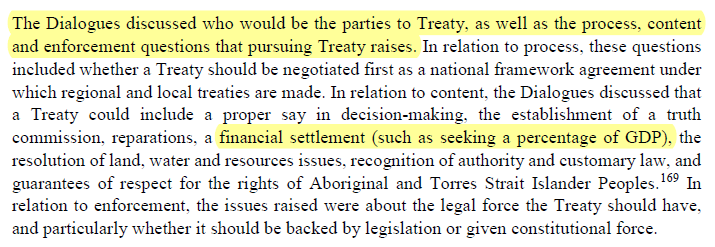
Excerpt from the full Uluru Statement (i.e., 26 page document)
Anthony Albanese might claim that those are merely goals for the Voice. The federal government would still need to agree. But, there are issues.
First, The Voice could credibly threaten to grind government slower if the government does not negotiate on a treaty. This is because The Voice has power to make representations to the executive government. Under basic legal principles, the government is bound to consider all “relevant” matters when making decisions. The Voice referendum deems its representations to be relevant, even if they are ridiculous. This enables the Voice to sue the government. The Voice body might lose. But, they have vast pools of tax payer funds to finance this. Further, bureaucrats would not want to deal with the stress of litigation and would acquiesce. Thus, the Voice can plausibly use legal processes as a cudgel should the government not acquiesce to reparation negotiations.
Second, the Voice has access and more access than other Australians. Being the person in the room gives you power. If the government never hears the counter-point to compensation, then the Voice will get its way. This is like only hearing one side of a court case. The outcome would be obvious.
Third, a government could undemocratically agree to compensation. When people vote for a party, they vote for varying reasons. They might elect a position despite, not because, of their stance on treaty. This is especially the case if treaty and reparations are barely covered in the campaign and are not widely known about. It is even worse if the politician springs a treaty on the public without first having taken it to an election. But, if that politician then pursues a treaty, it is not a given that the majority would actually agree to it. We are seeing this with the Voice referendum right now where Albanese was elected but the majority of Australians reject the Voice, according to recent polling.
The idea that reparations are not on the ballot is ridiculous. They very clearly are. Anthony Albanese’s comments on such simply do not hold up to scrutiny. His newfound opposition to reparations appears implausible and untenable.